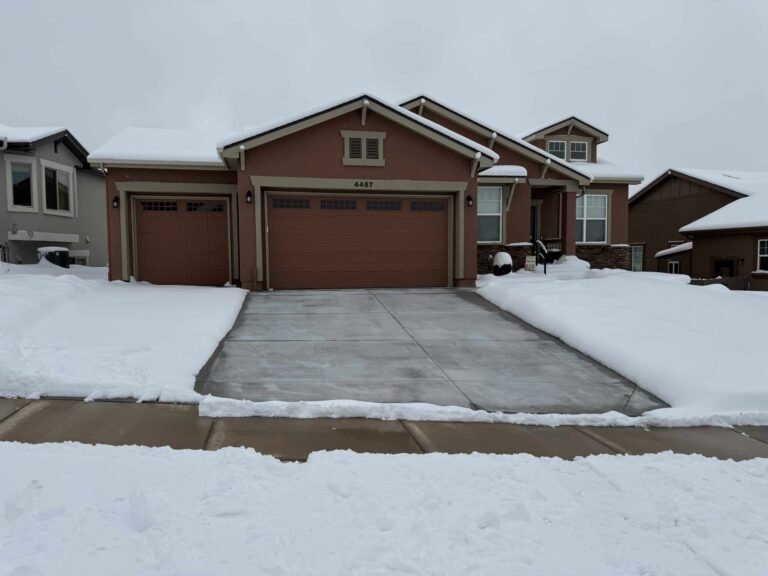
Learn more about national concrete standards from the American Concrete Institute (ACI). If you live in Fargo, you know the drill. You wake up at 6:00 AM to the sound of the wind howling. You check your phone: -15°F, wind chill -35°F, and four inches of fresh snow on the ground. Before you can even think about coffee, you have to bundle up, trudge outside, and wrestle with a frozen snowblower just to get your car out of the garage.
It’s a ritual every North Dakotan accepts—but more and more homeowners are deciding they are done with it.
The dream of a heated driveway—a “snow-melt” system that keeps your pavement dry and clear automatically—is becoming a popular request for our team here in Fargo. It feels like magic: while your neighbors are chipping away at ice dams, your driveway is steaming, dry, and safe.
But is it realistic for our climate? Can it handle a Red River Valley winter? And most importantly, how much does it actually cost?
As a local concrete contractor, I’m going to walk you through everything you need to know about snow-melt systems. We’ll look at the differences between electric and hydronic options, why “retrofitting” is usually a bad idea, and how to plan for a spring installation.
Is a Heated Driveway Right for Your Fargo Home?
When people call us asking about heated driveways, their first question is usually about luxury. But in North Dakota, a snow-melt system isn’t just about being fancy—it’s about safety and asset protection.
The Safety Factor
Slip-and-fall accidents are a major liability. For older homeowners or those with mobility issues, an icy driveway isn’t just an annoyance; it’s a danger zone. A properly installed heated driveway eliminates the invisible “black ice” that forms when snow melts during the day and refreezes at night. By keeping the surface temperature just above freezing, the concrete dries out completely, leaving you with zero slip hazards.
Protecting Your Concrete Investment
Here is a secret that salt manufacturers don’t want you to know: chemical de-icers are the number one enemy of concrete.
In Fargo, we deal with “freeze-thaw cycles.” Water gets into the tiny pores of your concrete, freezes, expands, and pops the surface off (a process called spalling). When you use rock salt or harsh chemicals, you accelerate this process. Salt lowers the freezing point of water, causing it to refreeze more often within the concrete.
A heated driveway eliminates the need for salt. No salt means no pitting, no spalling, and no chemical runoff into your lawn or our local storm drains. You are buying an insurance policy for the longevity of your concrete.
Hydronic vs. Electric: What Works Best in ND?
Not all snow-melt systems are created equal. When you are fighting -30°F temperatures, you need power. There are two main types of technology used to heat driveways: Electric and Hydronic.
Electric Systems (The “Toaster” Method)
Electric systems use resistance cables (similar to the heating element in a toaster or an electric blanket) embedded in the concrete.
How It Works
Thick, insulated cables are laid out in a serpentine pattern on the sub-base before the concrete is poured. They are wired into a control box and activated by moisture and temperature sensors.
The Pros
- Lower Upfront Cost: Electric cables are generally cheaper to buy and faster to install than hydronic tubing.
- Simplicity: There are fewer moving parts. No boilers, no pumps, no manifolds.
- Maintenance: Since there are no mechanical parts, there is very little maintenance required for the system itself.
The Cons for Fargo
- Operating Cost: Electricity is expensive. Heating a massive slab of concrete using nothing but amps is inefficient. In the dead of a Fargo winter, running an electric system for a large driveway can cause your utility bill to skyrocket.
- Capacity: Electric systems can struggle to keep up with rapid, heavy snowfall in extreme cold unless they are engineered with very high wattage per square foot.
Verdict: Electric is great for small areas—like heating just your front steps or a short sidewalk—but it is rarely the best choice for a full driveway in our region.
Hydronic Systems (The “Radiant” Method)
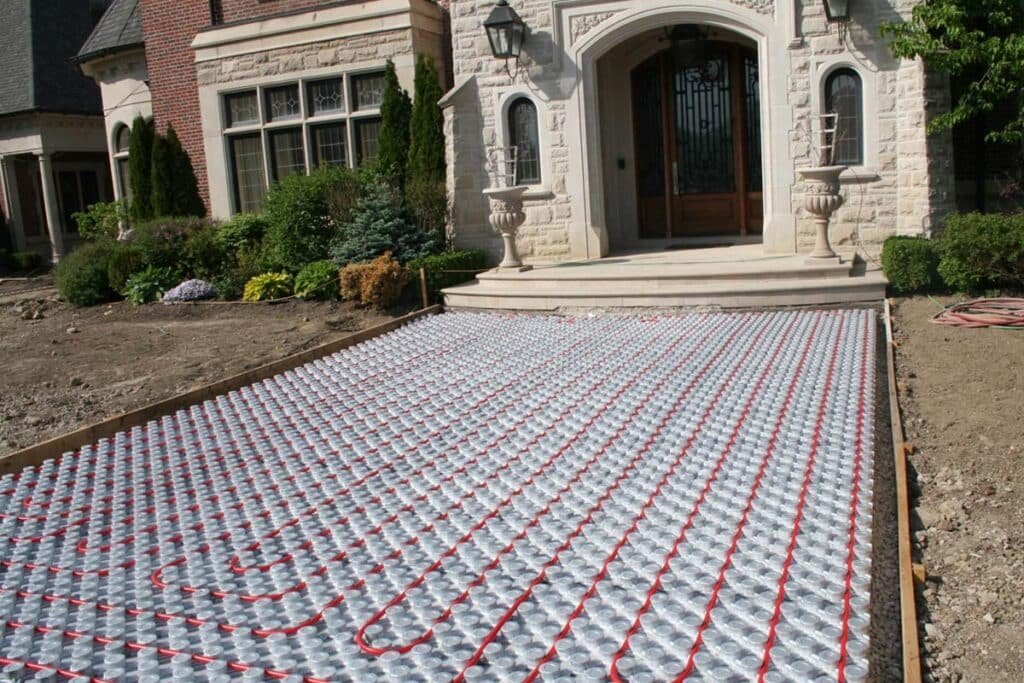
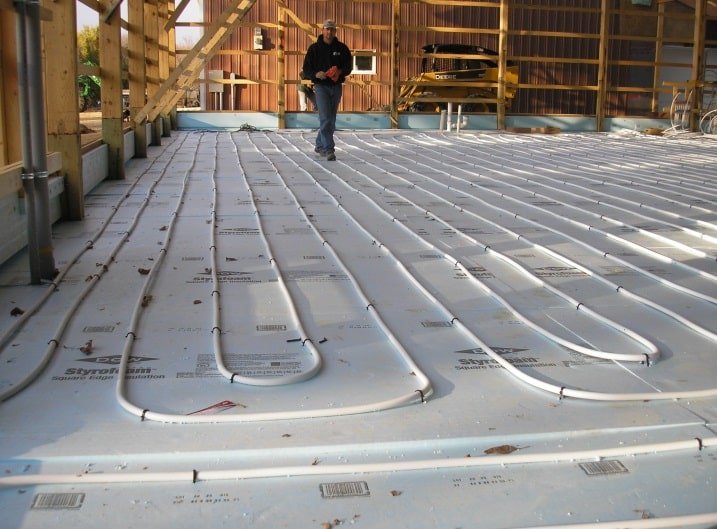
Hydronic systems are the gold standard for North Dakota. They use a closed-loop system of flexible PEX tubing to circulate a hot mixture of water and glycol (antifreeze) under the concrete.
How It Works
We install a boiler (usually a natural gas model) and a pump system in your garage or utility room. The boiler heats the glycol fluid, pumps it through the driveway tubing, and cycles it back for reheating.
The Pros
- Operating Cost: Natural gas is significantly cheaper than electricity in our area. A hydronic system costs a fraction of the price to run per storm compared to electric.
- Power: Hydronic systems pack a punch. They can generate enough BTUs to melt snow even in sub-zero conditions.
- Residual Heat: Because the fluid retains heat, the system stays warm longer, drying the concrete more efficiently.
The Cons
- High Upfront Cost: You are buying a boiler, pumps, manifolds, and tubing. The installation labor is more intensive.
- Space: You need wall space in your garage or mechanical room for the equipment.
Verdict: For a standard 2-car or 3-car driveway in Fargo, Hydronic is the superior choice. The upfront cost is higher, but the monthly savings and performance reliability make it the only serious option for our climate.
The "Retrofit" Myth: Can I Add Heat to My Existing Driveway?
This is the most common question we get: “My driveway is in okay shape. Can you just cut slots in it and add the wires?”
The short answer is: No.
The slightly longer answer is: Technically yes, but you will regret it.
Why Retrofitting Fails in Fargo
To make a heated driveway work in North Dakota, you aren’t just fighting the snow falling from the sky; you are fighting the frost deep in the ground.
If you lay heating cables on top of an existing driveway (and cover them with a new layer of concrete or pavers), or if you cut channels into the existing slab, you are missing the most critical component: Insulation.
The Importance of Insulation
Heat moves to cold. If you heat a concrete slab that is sitting directly on frozen Fargo soil, the physics of thermodynamics dictates that much of that heat will be sucked down into the frozen earth, not up to the snow. You will burn massive amounts of energy trying to thaw the permafrost below your house.
The Correct Way to Install
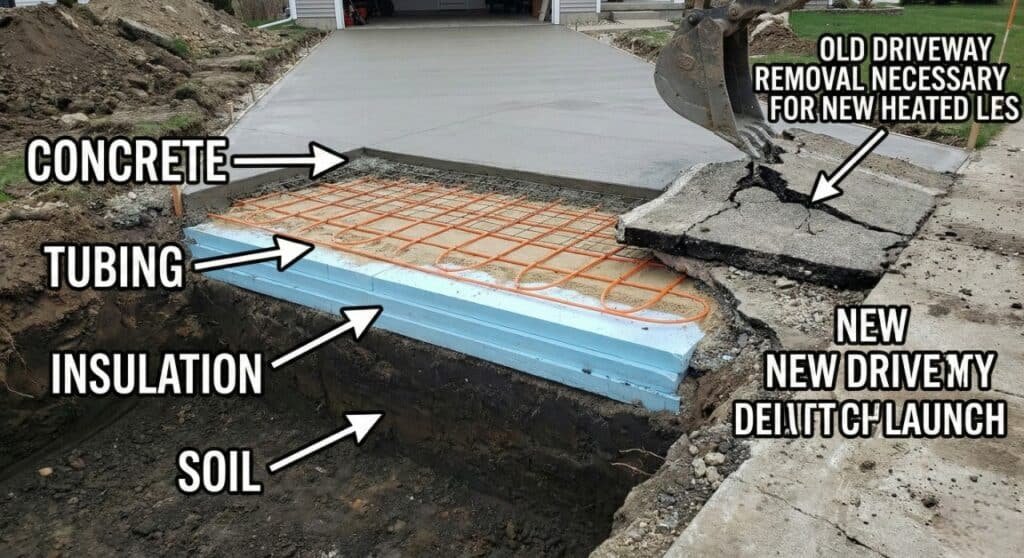
A proper installation requires a “thermal break.” Here is the layer-cake approach we use for a functional system:
- Compacted Sub-base: Stable soil support.
- Rigid Foam Insulation: A layer of high-density foam (usually 2 to 4 inches thick) is laid down first. This forces the heat to go UP, not down.
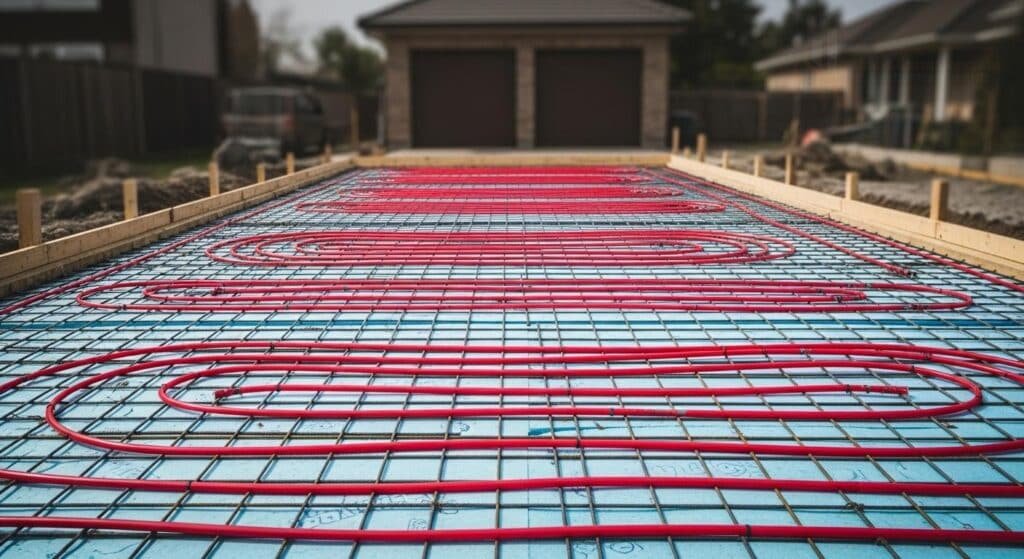
- The Heating Element: The PEX tubing or cables are tied to the rebar grid on top of the insulation.
- The Concrete: We pour the new slab over the tubes.
Because of the need for that insulation layer, you almost always need to tear out the old driveway to install a snow-melt system correctly. Trying to retrofit is a recipe for high energy bills and a system that can’t keep up with a blizzard.
Breakdown of Heated Driveway Costs in Fargo
Let’s talk numbers. Please note that these are rough market averages for 2026 and every project is unique, but this will give you a ballpark for budgeting.
Installation Costs
A standard concrete driveway replacement in Fargo might cost between $10 and $18 per square foot, depending on the finish (stamped vs. broom).
When you add a hydronic heated driveway system, you are adding:
- Demolition and disposal of old concrete.
- Site preparation and insulation installation.
- The boiler, pumps, sensors, and PEX tubing.
- Plumbing and electrical labor.
You should generally expect the cost to double or more compared to a standard driveway. You are essentially building a specialized radiator floor outside. For a typical 2-car driveway, you might be looking at an investment ranging from $15,000 to $30,000+ depending on the complexity and the boiler system selected.
Running Costs
Many homeowners fear the monthly bill, but modern systems are smart. They don’t run 24/7 all winter. They use moisture and temperature sensors. The system only turns on when it detects precipitation and freezing temperatures.
- Idling: Some systems “idle” at a low temperature to be ready for snow. This costs more but reacts faster.
- On-Demand: Most residential systems are “on-demand.” They fire up when the snow starts.
In Fargo, for an average winter, running a gas-fired hydronic system might cost between $200 and $500 for the entire season, depending on gas prices and snowfall amounts. Considering a professional plow service can cost $50-$75 per visit, the operating cost is surprisingly comparable.
The “Tire Track” Budget Option
If the budget is tight, we can design a system that only heats two 24-inch-wide strips where your tires go, plus a walkway to the door. This drastically reduces boiler size and material costs, though it leaves snow in the middle and sides of the driveway.
Planning for Spring 2026 Construction
Right now, the ground is frozen. We cannot pour concrete in January or February. However, if you want a heated driveway for next winter, you need to start planning now.
Why Start in Winter?
- Design & Engineering: Hydronic systems require engineering. We need to calculate the “heat load” (how many BTUs are needed) to size the boiler correctly. This takes time.
- Permitting: We need to secure permits for the demolition, concrete work, and gas/electrical connections.
- The Schedule: As soon as the frost lifts in May, the construction season in Fargo explodes. Contractors book up fast. If you wait until May to call, you might be pushed to an August or September install date.
The Installation Timeline
- Phase 1 (March/April): Consultation, design, and deposit.
- Phase 2 (May/June): Demolition of the old driveway.
- Phase 3 (June): Installation of insulation, rebar, and tubing. Pressure-testing the lines to ensure there are no leaks.
- Phase 4 (June): Pouring the concrete.
- Phase 5 (July/August): Hooking up the boiler and controls (can be done later in summer).
Conclusion: An Investment in Comfort
Is a heated driveway a necessity? No. But neither is air conditioning, and you wouldn’t build a house in Fargo without that.
A snow-melt system changes your relationship with winter. Instead of dreading the forecast, you can watch the snow fall knowing your property will take care of itself. It increases your home’s resale value, protects your family from falls, and saves your back from the heavy lifting.
Don’t wait until the spring rush.
If you are serious about upgrading your home this year, we are currently building our estimate list for Spring 2026. Let’s get the engineering done now so you can be the first project on the books when the ground thaws.
Contact us today for a free Heated Driveway consultation. Stop shoveling and start enjoying winter.