Author: Ali Jatoi

  • 2026 Guide to Residential Concrete Pricing in the Red River Valley

    2026 Guide to Residential Concrete Pricing in the Red River Valley

    Learn more about national concrete standards from the American Concrete Institute (ACI). If you have been browsing national home improvement websites to estimate the cost of your new driveway or patio in Fargo, you are likely setting yourself up for a shock. Those generic online calculators often cite averages from Florida or Texas—places where contractors can pour concrete directly onto sandy soil and walk away.

    In the Red River Valley, we do not have that luxury. We are building on top of ancient Lake Agassiz lakebed clay, a dense, expansive soil that moves like a living thing during our freeze-thaw cycles.

    At Solid State Concrete, we believe in radical transparency. We know that a sticker price of $10,000+ for a driveway can feel steep, but we also know that a $6,000 “bargain” driveway that heaves and cracks in two years is far more expensive in the long run.

    This guide is your honest, detailed breakdown of residential concrete pricing in the Red River Valley for 2026. We will cover the square-footage costs, the “hidden” factors that drive prices up in our region, and exactly what you should expect for your investment

    The Baseline: 2026 Price Ranges (Per Square Foot)

    Let’s get straight to the numbers. The following ranges represent installed costs (materials, labor, site prep, and finishing) for residential projects in the Fargo area for 2026.

    Note: These ranges assume a standard accessible site. Complex grading, tight access for ready-mix trucks, or pump truck requirements will adjust these figures.

    Standard Grey Concrete (Broom Finish)

    Price Range: $8.00 – $14.00 per sq. ft.

    This is the industry standard for driveways, garage aprons, and city sidewalks. “Broom finish” refers to the texture dragged across the wet concrete to provide traction—essential for safety during North Dakota winters.

    • What you get at the low end ($8 – $10): Typically a 4-inch slab with standard wire mesh reinforcement. This is often sufficient for sidewalks or patios that don’t carry heavy loads. However, be cautious of quotes in this range for a main driveway.
    • What you get at the high end ($11 – $14): A 5-to-6-inch slab reinforced with a rebar grid (usually #3 or #4 bar spaced 2 feet apart) and potentially fiber-mesh additives in the mix. This is the minimum recommendation for a durable driveway in Fargo.

    Decorative & Stamped Concrete

    Price Range: $14.00 – $28.00+ per sq. ft.

    Stamped concrete has surged in popularity across West Fargo and Horace as homeowners look to replace high-maintenance wood decks with permanent, rot-free patios.

    • Basic Stamp ($14 – $18): One base color, one release color (accent), and a seamless texture pattern (like slate or stone texture without deep grout lines). This creates a high-end look without the labor intensity of individual stone definitions.
    • Premium Stamp ($18 – $28+): This includes complex patterns (such as Ashlar Slate or Wood Plank), hand-stained individual stones for realism, and contrasting borders. This price range reflects the high skill level required; the crew has a limited window to stamp the pattern before the concrete sets, demanding a larger, more experienced team.

    Factors Influencing Residential Concrete Pricing in the Red River Valley

    The most expensive mistake you can make in Fargo is pouring concrete directly onto our native soil. Our clay is highly expansive. When it gets wet, it swells; when it dries, it shrinks. If your concrete is bonded directly to this soil, the slab will snap as the ground moves.

    To fix this, we have to “over-excavate.”

    • The Process: We dig out an extra 4 to 6 inches of soil below the slab depth.
    • The Fill: We import Class 5 gravel or crushed granite—material that drains well and doesn’t expand.
    • The Cost: You are paying for the excavation equipment, the hauling away of the heavy clay, and the trucking in of the new gravel. This process alone adds $2.00 – $4.00 per sq. ft. to the job compared to national averages, but it is the only way to ensure your driveway stays level.

    Reinforcement is Non-Negotiable

    In milder climates, contractors often use thin wire mesh (similar to chain-link fencing) to hold concrete together. In North Dakota, wire mesh is rarely enough.

    • The Standard: We use steel Rebar (reinforcing bar).
    • The Grid: We tie this rebar into a 2-foot by 2-foot grid, lifting it onto “chairs” so it sits in the exact center of the slab.
    • Why it costs more: Steel prices have fluctuated, but the labor to cut, tie, and position a rebar grid is significant. However, when the frost heaves the ground, that steel grid holds the slab together as one solid unit, preventing the “stair-step” cracking you see on older, cheaper driveways.

    The PSI Requirement

    We don’t use a “standard” concrete mix. We order “exterior air-entrained” mixes, usually rated at 4000 PSI (pounds per square inch) or higher.

    • Air Entrainment: This is a chemical additive that creates billions of microscopic air bubbles in the concrete. When moisture inside the concrete freezes in January, it expands into these bubbles rather than shattering the rock.

    The Premium: High-PSI, air-entrained mix costs more per yard from the batch plant, but it is critical for freeze-thaw durability.

    “Hidden” Costs You Must Budget For

    When analyzing residential concrete pricing in the Red River Valley, you must look beyond the per-square-foot number. A transparent quote from Solid State Concrete will always list these items separately or explicitly include them, so you aren’t surprised.

    Demolition & Disposal ($2.00 – $6.00 per sq. ft.)

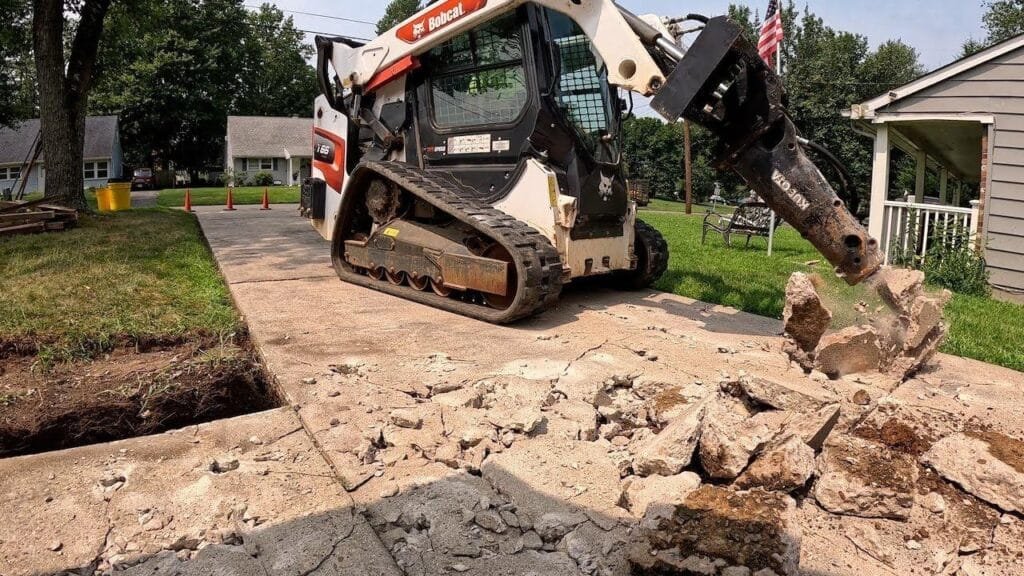
    If you have an existing cracked driveway, it needs to go. The cost depends on:

    • Reinforcement: Is there old rebar in the concrete? That makes it harder to break and cut.
    • Access: Can we get a skid steer right up to it, or do we have to wheelbarrow debris out?

    Disposal Fees: The local landfill in Fargo charges by weight. Concrete is heavy, and trucking costs have risen in 2026.
    Winter Heating Fees (Oct – April)

    If you are pushing to get your project done in late October or early April, the concrete plant charges a “Winter Service Fee.”

    • Heated Water: They use boiling water in the mix to ensure it doesn’t freeze in the truck.
    • Accelerators: Chemical additives (like calcium chloride or non-chloride accelerators) are added to make the concrete cure faster before the temperature drops at night.
    • Blankets: We may need to rent insulated curing blankets to cover the fresh slab for 3-7 days.
    • Budget Impact: Expect to add $300 – $600 to the total project cost for winter pours.

    Permits & City Approaches

    Every city in our area handles permits differently.

    • Fargo & West Fargo: Usually require a permit for driveway expansion or apron replacement. The city inspector must check the forms and rebar before we pour.
    • The “Apron” Factor: The section of the driveway between the sidewalk and the street is technically in the public right-of-way. Some municipalities require specific thicknesses (often 7 inches) for this section, which increases material costs.
    • Cost: Permit fees are generally nominal ($50-$150), but inspection time must be factored into the schedule.

    Sealing ($1.00 – $2.00 per sq. ft.)

    Curing and sealing are often confused.

    • Curing: Done immediately to help the concrete reach strength.

    Sealing: A penetrating siloxane or acrylic sealer applied after 30 days. This is what protects your driveway from the salt that drops off your car tires. While some contractors include this, many list it as an option. Our advice: Never skip the sealer in Fargo.

    Concrete vs. Asphalt vs. Pavers: A 2026 Comparison

    Homeowners often ask if they can save money by choosing asphalt or pavers. Here is how residential concrete pricing in the Red River Valley compares to the alternatives in 2026.
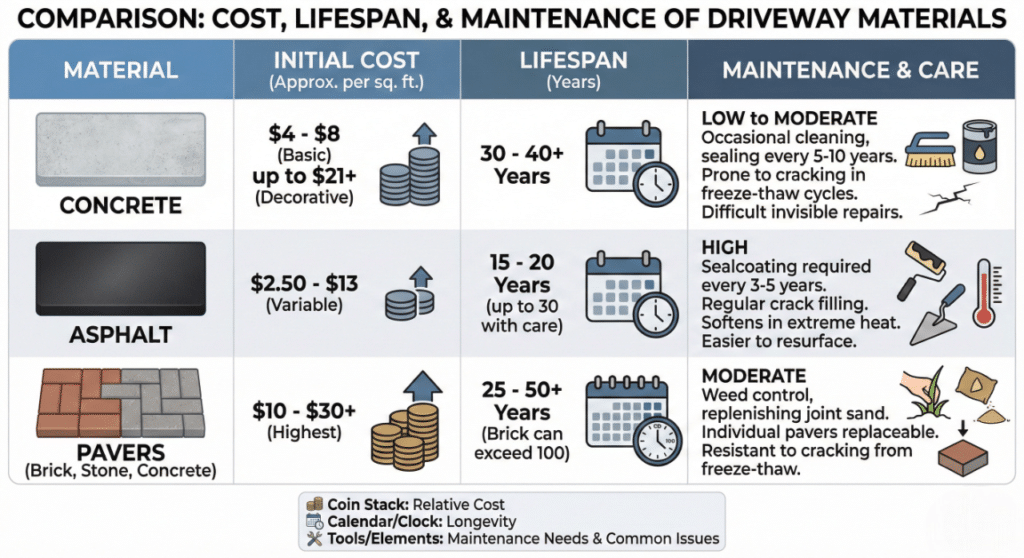
    Infographic or Table Chart comparing Cost, Lifespan, and Maintenance of Concrete vs. Asphalt vs. Pavers

    Concrete vs. Asphalt

    • Asphalt Cost: Generally 30-40% cheaper upfront than concrete.
    • The Trade-off: Asphalt is flexible, which is good for frost heave, but it requires seal coating every 2-3 years. In our hot summers, asphalt softens and can be scarred by motorcycle kickstands or trailer jacks.
    • Longevity: A well-poured concrete driveway lasts 30-50 years. An asphalt driveway typically lasts 15-20 years before needing a complete overlay.

    Concrete vs. Pavers

    • Paver Cost: Generally 20-30% more expensive than stamped concrete.
    • The Trade-off: Pavers are beautiful and individual bricks can be replaced if they crack. However, in the Red River Valley clay, maintaining a perfectly level paver surface is difficult. As the ground heaves, pavers shift, leading to uneven surfaces that are a nightmare to shovel in winter.
    • Weeds: Pavers have joints; concrete does not. Unless you use expensive polymeric sand (and re-apply it every few years), you will be weeding your driveway.

    Project Examples: Real World Math

    To help you visualize the budget, here are two hypothetical examples based on typical Fargo homes. These breakdowns illustrate how residential concrete pricing in the Red River Valley translates into a final invoice.

    Example A: The “South Fargo” Driveway Replacement

    Scenario: A 1990s home with a cracked, heaving driveway. The homeowner wants a complete replacement with a new, wider apron.

    • Size: 750 sq. ft.
    • Scope:
      • Break out and haul away old concrete ($3,000).
      • Excavate wet clay and install 6″ Class 5 gravel base.
      • Install #4 Rebar grid (2′ on center).
      • Pour 4500 PSI air-entrained concrete (5 inches thick).
      • Broom finish with hand-tooled edges.
    • Estimated Total: $10,500 – $13,000

    Timeline: 3-4 days (weather permitting).
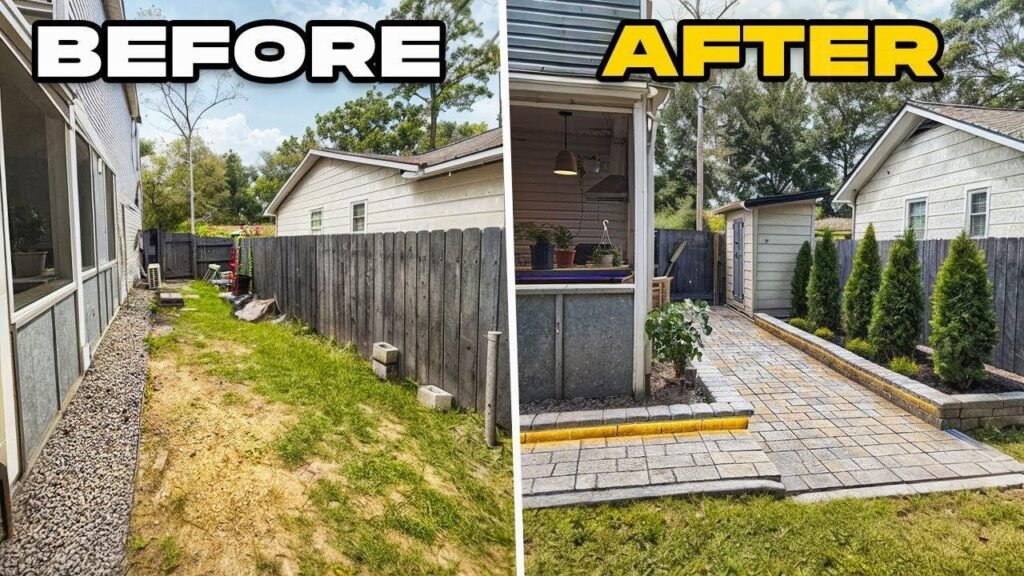
    Before and After" slider or side-by-side shot of a backyard patio transformation.

    Example B: The “West Fargo” Backyard Oasis

    Scenario: A new build home with a dirt backyard. The homeowner wants a stamped patio for entertaining.

    • Size: 400 sq. ft.
    • Scope:
      • Grass removal and site grading.
      • 4″ compacted gravel base.
      • Reinforced slab.
      • Pattern: “Ashlar Slate” stamp.
      • Color: “Slate Grey” integral color with “Charcoal” release (two-tone).
      • High-gloss acrylic sealer with “Shark Grip” (anti-slip additive).
    • Estimated Total: $7,200 – $9,500
    • Timeline: 4-5 days (stamping and sealing requires dry weather).

    Maintenance: Protecting Your Investment

    One factor that significantly affects the “lifetime cost” of your concrete is maintenance. While concrete is durable, it is not invincible—especially against salt.

    The “Salt” Danger

    In Fargo, city plows drop magnesium chloride and rock salt. You drive through it, park in your driveway, and the salty slush drips onto the concrete.

    • The Damage: Salt lowers the freezing point of water, increasing the number of freeze-thaw cycles the surface endures. It can also chemically attack the cement paste, leading to pitting.
    • The Solution: We recommend a high-quality penetrating sealer applied every 3 years. This costs roughly $0.50 per square foot if you DIY, or $1.50 per square foot if you hire a pro.

    The “Caulk” Strategy

    The expansion joints (the cuts we make in the concrete) are there to control cracking. However, they can also let water seep under the slab.

    • The Fix: Using a self-leveling concrete caulk (like Sikaflex) in these joints prevents water from getting under the slab and freezing. This small $200 investment can extend the life of your driveway by a decade.

    The “Lowest Bidder” Warning

    In the construction world, there is an old saying: “The bitterness of poor quality remains long after the sweetness of low price is forgotten.”

    This is especially true when discussing residential concrete pricing in the Red River Valley. In our market, the “lowest bidder” usually achieves that price by cutting one of three corners:

    1. Thinner Concrete: Pouring 3.5 inches instead of a full 4 or 5 inches. You won’t notice the difference until a delivery truck cracks it.
    2. Skimping on Base: Pouring on dirt instead of buying gravel. This saves the contractor trucking fees and material costs, but guarantees your slab will heave.
    3. Watering Down the Mix: Adding water to the truck on-site makes the concrete flow like soup, which makes it easier for the crew to spread. However, excess water weakens the chemical bond of the concrete, leading to flaking (spalling) in the first winter.

    At Solid State Concrete, we don’t play those games. We build driveways and patios designed to survive North Dakota. We provide detailed, written estimates that specify the PSI of the mix, the thickness of the gravel base, and the gauge of the rebar.

    Ready to plan your 2026 project?

    The construction season in the Red River Valley is short. If you are considering a new driveway or patio for this summer, the time to start the conversation is now.

    Contact Solid State Concrete today for a free site assessment. Let’s build something solid.

  • Sick of Shoveling? The Truth About Installing a Heated Driveway in Fargo (2026 Guide)

    Sick of Shoveling? The Truth About Installing a Heated Driveway in Fargo (2026 Guide)

    Learn more about national concrete standards from the American Concrete Institute (ACI). If you live in Fargo, you know the drill. You wake up at 6:00 AM to the sound of the wind howling. You check your phone: -15°F, wind chill -35°F, and four inches of fresh snow on the ground. Before you can even think about coffee, you have to bundle up, trudge outside, and wrestle with a frozen snowblower just to get your car out of the garage.

    It’s a ritual every North Dakotan accepts—but more and more homeowners are deciding they are done with it.

    The dream of a heated driveway—a “snow-melt” system that keeps your pavement dry and clear automatically—is becoming a popular request for our team here in Fargo. It feels like magic: while your neighbors are chipping away at ice dams, your driveway is steaming, dry, and safe.

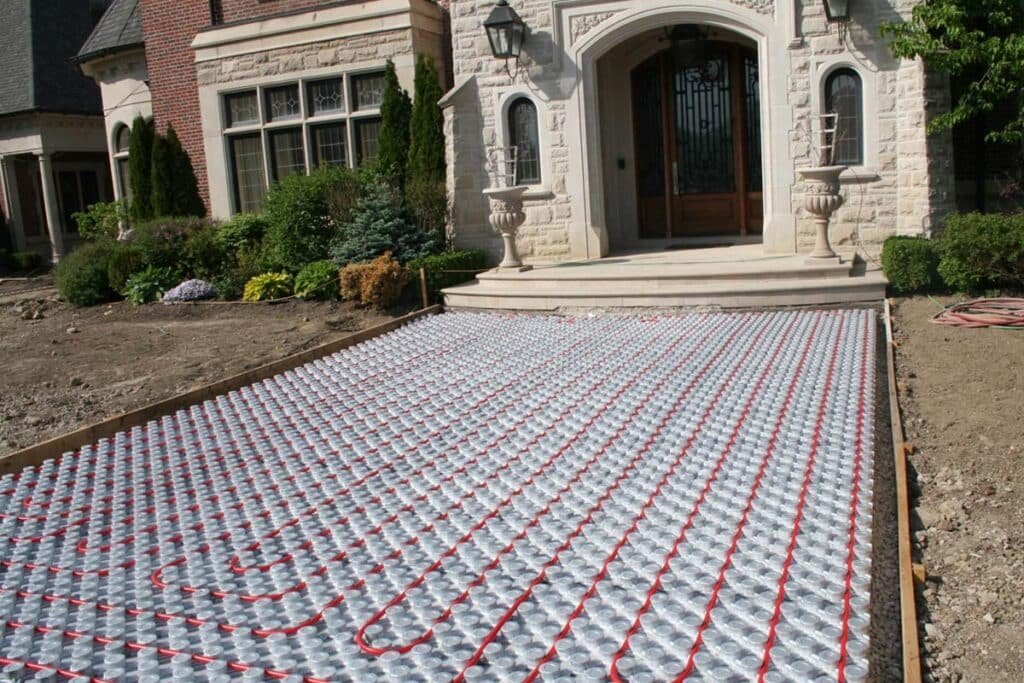
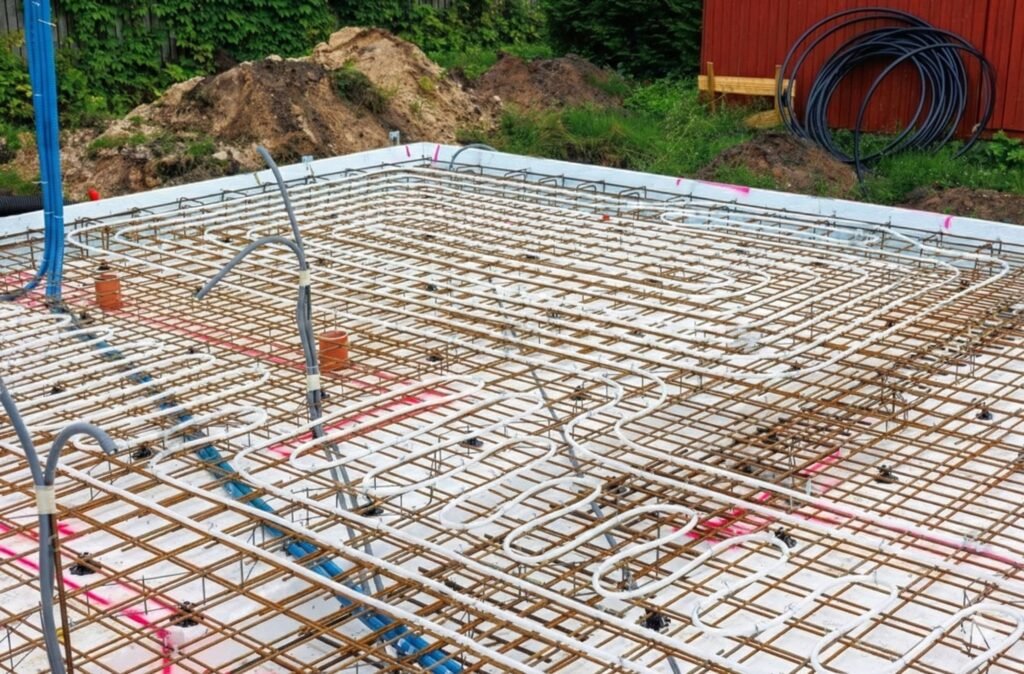
    "Heated driveway installation PEX"

    But is it realistic for our climate? Can it handle a Red River Valley winter? And most importantly, how much does it actually cost?

    As a local concrete contractor, I’m going to walk you through everything you need to know about snow-melt systems. We’ll look at the differences between electric and hydronic options, why “retrofitting” is usually a bad idea, and how to plan for a spring installation.

    Is a Heated Driveway Right for Your Fargo Home?

    When people call us asking about heated driveways, their first question is usually about luxury. But in North Dakota, a snow-melt system isn’t just about being fancy—it’s about safety and asset protection.

    The Safety Factor

    Slip-and-fall accidents are a major liability. For older homeowners or those with mobility issues, an icy driveway isn’t just an annoyance; it’s a danger zone. A properly installed heated driveway eliminates the invisible “black ice” that forms when snow melts during the day and refreezes at night. By keeping the surface temperature just above freezing, the concrete dries out completely, leaving you with zero slip hazards.

    Protecting Your Concrete Investment

    Here is a secret that salt manufacturers don’t want you to know: chemical de-icers are the number one enemy of concrete.

    In Fargo, we deal with “freeze-thaw cycles.” Water gets into the tiny pores of your concrete, freezes, expands, and pops the surface off (a process called spalling). When you use rock salt or harsh chemicals, you accelerate this process. Salt lowers the freezing point of water, causing it to refreeze more often within the concrete.

    A heated driveway eliminates the need for salt. No salt means no pitting, no spalling, and no chemical runoff into your lawn or our local storm drains. You are buying an insurance policy for the longevity of your concrete.

    Hydronic vs. Electric: What Works Best in ND?

    Not all snow-melt systems are created equal. When you are fighting -30°F temperatures, you need power. There are two main types of technology used to heat driveways: Electric and Hydronic.

    Electric Systems (The “Toaster” Method)

    Electric systems use resistance cables (similar to the heating element in a toaster or an electric blanket) embedded in the concrete.

    How It Works

    Thick, insulated cables are laid out in a serpentine pattern on the sub-base before the concrete is poured. They are wired into a control box and activated by moisture and temperature sensors.

    The Pros

    • Lower Upfront Cost: Electric cables are generally cheaper to buy and faster to install than hydronic tubing.
    • Simplicity: There are fewer moving parts. No boilers, no pumps, no manifolds.
    • Maintenance: Since there are no mechanical parts, there is very little maintenance required for the system itself.

    The Cons for Fargo

    • Operating Cost: Electricity is expensive. Heating a massive slab of concrete using nothing but amps is inefficient. In the dead of a Fargo winter, running an electric system for a large driveway can cause your utility bill to skyrocket.
    • Capacity: Electric systems can struggle to keep up with rapid, heavy snowfall in extreme cold unless they are engineered with very high wattage per square foot.

    Verdict: Electric is great for small areas—like heating just your front steps or a short sidewalk—but it is rarely the best choice for a full driveway in our region.

    Hydronic Systems (The “Radiant” Method)

    Hydronic systems are the gold standard for North Dakota. They use a closed-loop system of flexible PEX tubing to circulate a hot mixture of water and glycol (antifreeze) under the concrete.

    How It Works

    We install a boiler (usually a natural gas model) and a pump system in your garage or utility room. The boiler heats the glycol fluid, pumps it through the driveway tubing, and cycles it back for reheating.

    The Pros

    • Operating Cost: Natural gas is significantly cheaper than electricity in our area. A hydronic system costs a fraction of the price to run per storm compared to electric.
    • Power: Hydronic systems pack a punch. They can generate enough BTUs to melt snow even in sub-zero conditions.
    • Residual Heat: Because the fluid retains heat, the system stays warm longer, drying the concrete more efficiently.

    The Cons

    • High Upfront Cost: You are buying a boiler, pumps, manifolds, and tubing. The installation labor is more intensive.
    • Space: You need wall space in your garage or mechanical room for the equipment.

    Verdict: For a standard 2-car or 3-car driveway in Fargo, Hydronic is the superior choice. The upfront cost is higher, but the monthly savings and performance reliability make it the only serious option for our climate.

    The “Retrofit” Myth: Can I Add Heat to My Existing Driveway?

    This is the most common question we get: “My driveway is in okay shape. Can you just cut slots in it and add the wires?”

    The short answer is: No.

    The slightly longer answer is: Technically yes, but you will regret it.

    Why Retrofitting Fails in Fargo

    To make a heated driveway work in North Dakota, you aren’t just fighting the snow falling from the sky; you are fighting the frost deep in the ground.

    If you lay heating cables on top of an existing driveway (and cover them with a new layer of concrete or pavers), or if you cut channels into the existing slab, you are missing the most critical component: Insulation.

    The Importance of Insulation

    Heat moves to cold. If you heat a concrete slab that is sitting directly on frozen Fargo soil, the physics of thermodynamics dictates that much of that heat will be sucked down into the frozen earth, not up to the snow. You will burn massive amounts of energy trying to thaw the permafrost below your house.

    The Correct Way to Install

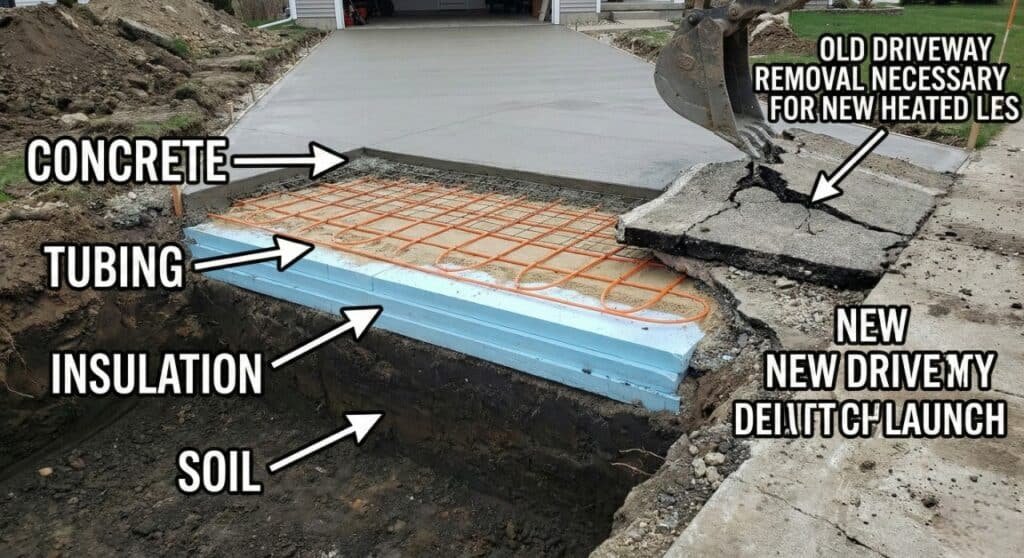
    A proper installation requires a “thermal break.” Here is the layer-cake approach we use for a functional system:

    1. Compacted Sub-base: Stable soil support.
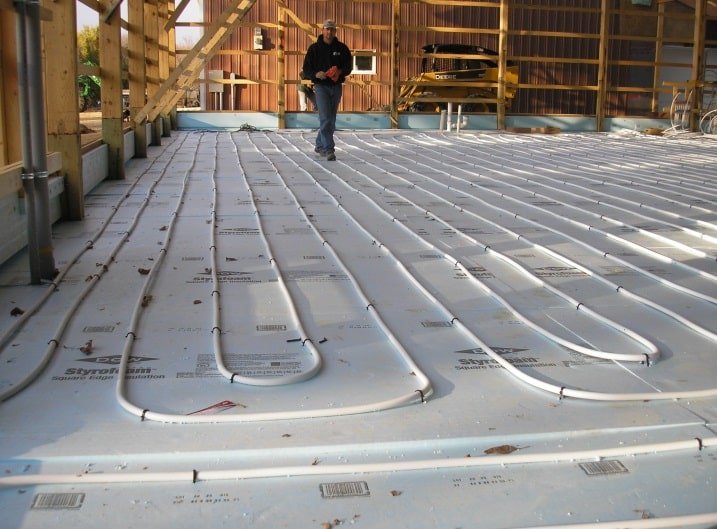
    2. Rigid Foam Insulation: A layer of high-density foam (usually 2 to 4 inches thick) is laid down first. This forces the heat to go UP, not down.
    3. The Heating Element: The PEX tubing or cables are tied to the rebar grid on top of the insulation.
    4. The Concrete: We pour the new slab over the tubes.

    Because of the need for that insulation layer, you almost always need to tear out the old driveway to install a snow-melt system correctly. Trying to retrofit is a recipe for high energy bills and a system that can’t keep up with a blizzard.

    Breakdown of Heated Driveway Costs in Fargo

    Let’s talk numbers. Please note that these are rough market averages for 2026 and every project is unique, but this will give you a ballpark for budgeting.

    Installation Costs

    A standard concrete driveway replacement in Fargo might cost between $10 and $18 per square foot, depending on the finish (stamped vs. broom).

    When you add a hydronic heated driveway system, you are adding:

    • Demolition and disposal of old concrete.
    • Site preparation and insulation installation.
    • The boiler, pumps, sensors, and PEX tubing.
    • Plumbing and electrical labor.

    You should generally expect the cost to double or more compared to a standard driveway. You are essentially building a specialized radiator floor outside. For a typical 2-car driveway, you might be looking at an investment ranging from $15,000 to $30,000+ depending on the complexity and the boiler system selected.

    Running Costs

    Many homeowners fear the monthly bill, but modern systems are smart. They don’t run 24/7 all winter. They use moisture and temperature sensors. The system only turns on when it detects precipitation and freezing temperatures.

    • Idling: Some systems “idle” at a low temperature to be ready for snow. This costs more but reacts faster.
    • On-Demand: Most residential systems are “on-demand.” They fire up when the snow starts.

    In Fargo, for an average winter, running a gas-fired hydronic system might cost between $200 and $500 for the entire season, depending on gas prices and snowfall amounts. Considering a professional plow service can cost $50-$75 per visit, the operating cost is surprisingly comparable.

    The “Tire Track” Budget Option

    If the budget is tight, we can design a system that only heats two 24-inch-wide strips where your tires go, plus a walkway to the door. This drastically reduces boiler size and material costs, though it leaves snow in the middle and sides of the driveway.

    Planning for Spring 2026 Construction

    Right now, the ground is frozen. We cannot pour concrete in January or February. However, if you want a heated driveway for next winter, you need to start planning now.

    Why Start in Winter?

    1. Design & Engineering: Hydronic systems require engineering. We need to calculate the “heat load” (how many BTUs are needed) to size the boiler correctly. This takes time.
    2. Permitting: We need to secure permits for the demolition, concrete work, and gas/electrical connections.
    3. The Schedule: As soon as the frost lifts in May, the construction season in Fargo explodes. Contractors book up fast. If you wait until May to call, you might be pushed to an August or September install date.

    The Installation Timeline

    • Phase 1 (March/April): Consultation, design, and deposit.
    • Phase 2 (May/June): Demolition of the old driveway.
    • Phase 3 (June): Installation of insulation, rebar, and tubing. Pressure-testing the lines to ensure there are no leaks.
    • Phase 4 (June): Pouring the concrete.
    • Phase 5 (July/August): Hooking up the boiler and controls (can be done later in summer).

    Conclusion: An Investment in Comfort

    Is a heated driveway a necessity? No. But neither is air conditioning, and you wouldn’t build a house in Fargo without that.

    A snow-melt system changes your relationship with winter. Instead of dreading the forecast, you can watch the snow fall knowing your property will take care of itself. It increases your home’s resale value, protects your family from falls, and saves your back from the heavy lifting.

    Don’t wait until the spring rush.

    If you are serious about upgrading your home this year, we are currently building our estimate list for Spring 2026. Let’s get the engineering done now so you can be the first project on the books when the ground thaws.

    Contact us today for a free Heated Driveway consultation. Stop shoveling and start enjoying winter.

  • The Ultimate Guide to Heated Stamped Concrete Driveways in Fargo

    The Ultimate Guide to Heated Stamped Concrete Driveways in Fargo

    Learn more about national concrete standards from the American Concrete Institute (ACI). If you live in the Red River Valley, you know the routine. The weather forecast predicts a “Alberta Clipper,” and by morning, you are staring at three feet of heavy, drifted snow blocking your garage. The wind chill is -30°F. Your snowblower won’t start. And you have a meeting in 45 minutes.

    For decades, this struggle has been a mandatory part of life in Fargo, North Dakota. But for a growing number of homeowners, the morning snow battle is a thing of the past.

    Imagine waking up after a blizzard to a driveway that is clear, dry, and safe—without lifting a shovel.

    This is the reality of heated stamped concrete driveways.

    At Solid State Concrete, your driveway should be more than just a place to park your car; it should be a functional asset that improves your quality of life. In this comprehensive guide, we will explore everything you need to know about heated driveways: how they work, why they are the perfect match for decorative stamped concrete, and whether the investment makes sense for your Fargo home.

    Part 1: What Exactly is a Heated Stamped Concrete Driveway?

    The “Heated” Part: Radiant Snow Melting

    Unlike traditional heating methods that blow hot air into a space, a heated driveway uses radiant heat. This technology warms the mass of the concrete slab itself, turning the entire driveway into a gentle heating element.

    Because concrete is a dense material, it holds heat exceptionally well. When the system is active, it raises the surface temperature of the concrete just enough—usually to around 38°F to 40°F—to melt snow as it lands and prevent ice from bonding to the surface.

    The “Stamped” Part: Decorative Artistry

    Historically, heated driveways were purely utilitarian—often just plain, grey slabs. But today, homeowners demand curb appeal. Stamped concrete involves pressing heavy rubber mats into the wet concrete to simulate the texture and shape of high-end materials like:

    • Slate

    • Flagstone

    • Brick

    • Weathered Wood

    • Cobblestone

    The result is a driveway that looks like a luxury stone installation but performs like a high-tech machine.

    Part 2: Hydronic vs. Electric Systems – Which is Right for Fargo?

    When planning a heated driveway in North Dakota, you generally have two system options: Hydronic (liquid-based) or Electric (wire-based). Understanding the difference is critical for our climate.

    1. Hydronic Systems (The Fargo Standard)

    Hydronic systems are the most common choice for large driveways in cold climates.

    How it works: We install a network of flexible, durable PEX (cross-linked polyethylene) tubing within the concrete slab. This tubing circulates a mixture of hot water and propylene glycol (anti-freeze). The fluid is heated by a boiler located in your garage or mechanical room.

    The Pros:

    • Lower Operating Cost: Generally cheaper to run day-to-day than electric, especially for large areas.

    • Durability: PEX tubing is incredibly tough and resistant to crushing.

    • Power Source: Can run on natural gas, which is often more cost-effective in ND than electricity for high-load heating.

    The Cons: Higher upfront installation cost due to the need for a boiler, pumps, and manifolds.

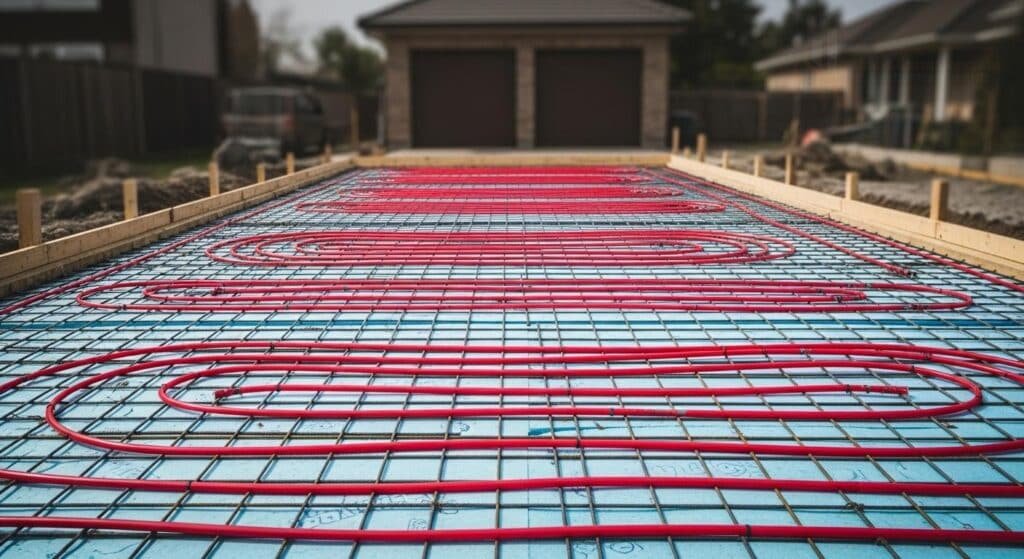
    Construction photo showing the PEX tubing grid looped over rebar before the concrete is poured

    2. Electric Systems

    Electric systems use resistance cables (similar to heated bathroom floors) embedded in the concrete.

    How it works: Electric cables generate heat when current flows through them. They are wired directly into your home’s electrical panel.

    The Pros: Lower upfront installation cost (no boiler needed), fewer moving parts, and silent operation.

    The Cons:

    • High Operating Cost: In extreme cold, heating a large driveway with electricity can be very expensive.

    • Capacity Limits: A large driveway might require a significant upgrade to your home’s electrical service panel (e.g., upgrading to 400 amps) to handle the load.

    Our Verdict for Fargo: For small walkways or front stoops, electric is fine. For a full 2-car or 3-car driveway in North Dakota, Hydronic is almost always the superior choice for long-term efficiency and power.

    Part 3: The “Secret” Benefit: Why Heat Protects Your Concrete

    Most people buy heated driveways for convenience. But as concrete contractors, we love them for a different reason: Longevity.

    Fargo’s climate is brutal on concrete for two reasons: Freeze-Thaw Cycles and Chemical Damage. A heated system solves both.

    The Problem with Freeze-Thaw

    Concrete is porous. In spring and fall, water seeps into those tiny pores. When the temperature drops below freezing at night, that water expands by 9%, creating internal pressure that cracks and flakes (spalls) the surface.

    The Solution: A heated driveway evaporates moisture. By keeping the slab dry and maintaining a steady temperature during storms, it drastically reduces the number of freeze-thaw shocks the concrete endures.

    The Problem with Salt

    We salt our roads and driveways to melt ice. But salt is corrosive. It attacks the chemical bonds in the concrete paste, leading to pitting and crumbling.

    The Solution: With a heated driveway, you never need to buy salt again. You eliminate the #1 enemy of concrete from your property entirely. This is why heated slabs often look pristine 20 years later, while their non-heated neighbors are pitted and cracked.

    Part 4: Designing Your Dream Driveway

    Just because it’s functional doesn’t mean it has to be boring. At Solid State Concrete, we specialize in high-end decorative finishes. Here are the top design trends we are seeing for 2026:

    1. The Seamless Slate Look

    Seamless skins impart a natural stone texture without the deep grout lines of a pattern stamp. Why it works with heat: Seamless textures are fantastic for snow melting because there are no deep crevices for water to pool in if the system is turned off. It provides a modern, expansive look.

    2. Ashlar Slate

    This is the “King of Stamps.” It features rectangular and square stones arranged in a random, interlocking pattern. The Aesthetic: It mimics cut stone found in historic estates. It pairs beautifully with brick or siding homes common in Fargo.


    3. Borders and Bands

    A popular trend is to use a contrasting border. For example, a “London Cobble” border in a charcoal color, framing a main driveway stamped in a seamless texture with a lighter grey tone. The Function: The border acts as a visual guide for drivers and adds a “finished” look that increases curb appeal significantly.

    4. Color Choices for North Dakota

    Darker colors absorb sunlight, which naturally helps melt snow on sunny days (passive solar gain). Recommendation: We often recommend “Integral Colors” (mixed into the concrete) in shades of slate grey, charcoal, or terracotta. These colors hide road grime and tire marks better than lighter creams or tans.

    Part 5: The Installation Process (Step-by-Step)

    Installing a heated stamped concrete driveway is a major construction project. Transparency is key, so here is exactly what happens when you hire Solid State Concrete for this job.

    Step 1: Demolition and Excavation

    We remove your old, cracked driveway. But we don’t just stop there. For a heated driveway, we may need to excavate slightly deeper to accommodate insulation.

    Step 2: The Sub-Base & Insulation (Critical Step!)

    This is where amateurs fail. You cannot put heating tubes directly on cold ground. The heat will sink into the earth (energy loss).

    We install a layer of rigid foam insulation (high-density polystyrene) under the entire driveway. This ensures the heat goes UP into the concrete, not DOWN into the dirt. This maximizes efficiency and lowers your heating bills.

    [INSERT IMAGE 5: Process Shot – Photo of the excavation site lined with pink/blue rigid foam insulation boards.]

    Step 3: Rebar and Tubing

    We install a grid of steel rebar for structural strength. Then, we tie the PEX tubing to the rebar in serpentine loops, spaced about 6 to 9 inches apart. We carefully pressure-test the tubing before we pour to ensure there are no leaks.

    Step 4: The Pour

    We pour high-strength concrete (4000+ PSI) specifically mixed for North Dakota’s climate. We are careful not to damage the tubing during the pour.

    Step 5: Stamping and Texturing

    While the concrete is still wet (plastic state), we apply color hardeners and release agents, then press the rubber stamps into the surface. This requires precision timing.

    Step 6: Control Joints and Sealing

    Once the concrete cures, we saw-cut control joints to manage cracking. Finally, we apply a penetrating sealer that enhances the color and protects the surface from stains.

    Step 7: System Hookup

    A licensed plumber and electrician will connect your PEX loops to the boiler and the sensor system.

    Part 6: Cost vs. Value Analysis

    Let’s address the elephant in the room: Cost. A heated stamped concrete driveway is a premium product. It costs significantly more than a standard pour. But is it worth it?

    The “Time is Money” Equation: How much is your time worth? If you spend 40 hours a winter shoveling or blowing snow, that is a work-week of your life lost every year. Professional Removal: Hiring a plow service in Fargo costs $500 to $800 per season. Over 10 years, that is $5,000–$8,000 spent on a service that often leaves a layer of hard-pack ice behind.

    The Liability Factor: One slip-and-fall lawsuit, or one bad hip fracture on an icy patch, costs far more than a heated driveway. For business owners or homeowners with public sidewalks, the liability reduction alone justifies the cost.

    Resale Value In the Fargo real estate market, “Heated Driveway” is a keyword that stops scrollers in their tracks. It signals a luxury, well-maintained home. You will likely recoup a significant portion of the installation cost upon resale.

    Part 7: Frequently Asked Questions (FAQ)

    Q: Do I have to turn it on manually every time it snows? A: No. The best systems use automated sensors (puck sensors) embedded in the concrete. They detect temperature and moisture. If it’s snowing, the system turns on. When the driveway is dry, it turns off. You don’t have to lift a finger.

    Q: Can I heat my existing driveway? A: No. We cannot retroactively install tubing inside hardened concrete. However, we can tear out your old driveway and pour a new heated one. This is a very common renovation project in Fargo.

    Q: Will the stamping wear off? A: Stamped texture is permanent; it is the concrete itself. The color may fade slightly over many years, but this is easily refreshed with a reseal. Because you aren’t scraping it with metal shovel blades or plow trucks, the texture actually stays sharper longer on a heated driveway.

    Q: What happens if the power goes out during a blizzard? A: The system will stop heating. However, once power is restored, the system will kick back on. Because concrete has high thermal mass, it may take a few hours to catch up, but it will eventually melt the accumulation.

    Q: Is it environmentally friendly? A: It can be. By eliminating the need for rock salt and chloride chemicals, you are preventing runoff that damages our local waterways and kills your lawn/landscaping.

    Part 8: Maintenance for Your Heated Stamped Driveway

    Even a “magic” driveway needs a little love. Here is how to care for your investment:

    • Reseal Every 2-3 Years: The sealer protects the color and blocks stain penetration.

    • Inspect the Boiler: Just like your home furnace, have your glycol boiler checked annually to ensure fluid levels and pressure are correct.

    • No Heavy Trucks: While residential driveways are strong, avoid parking heavy delivery trucks or dumpsters on the edge of the slab.

    • Avoid Metal Shovels: Even though you won’t need to shovel often, if you do (perhaps to clear a path for a pet), use a plastic shovel to avoid scratching the decorative sealer.


    Conclusion: Upgrade Your Winter

    Living in Fargo, ND, requires resilience. But it doesn’t require suffering.

    A heated stamped concrete driveway transforms the worst part of winter into a non-event. It gives you back your mornings. It keeps your family safe. And it adds a level of beauty and sophistication to your home that standard grey concrete simply cannot match.

    If you are ready to retire your snow shovel and upgrade your home’s exterior, Solid State Concrete is here to help. We are Fargo’s experts in decorative and heated concrete solutions.

    Ready to melt the snow? Contact us today, fill out our online form for a free consultation and estimate on your heated driveway project. Let’s make this the last winter you ever worry about the forecast.

  • Jeton Rouge Casino : examiner l’expérience avant de miser

    Un casino en ligne se juge moins à ses néons virtuels qu’à ce qui se passe après le premier clic : règles accessibles, paiements compréhensibles et outils de jeu responsable. Jeton Rouge Casino mérite donc une lecture attentive, sans confondre une vitrine soignée avec une garantie de qualité. Dans le jeu d’argent, le tapis rouge cache parfois une petite ligne en caractères minuscules.

    Pour consulter la plateforme et ses informations, rendez-vous sur https://jetonrouge-casino.app/. Avant de créer un compte ou de déposer, vérifiez les conditions applicables à votre pays, l’identité de l’exploitant et les règles de retrait. Ces vérifications paraissent moins distrayantes qu’une roue qui tourne, mais elles évitent que la partie ne se transforme en enquête administrative.

    Une première impression ne suffit pas

    La présentation d’un casino peut donner le ton : menus clairs, catégories lisibles et accès rapide aux règles rendent la navigation moins laborieuse. Pourtant, l’apparence ne renseigne ni sur la fiabilité des paiements ni sur la qualité du service client. Un tapis vert reste un tapis, même lorsqu’il est parfaitement repassé.

    Le premier contrôle consiste à repérer les informations légales, les coordonnées de l’opérateur et les conditions d’utilisation. Cherchez aussi les mentions concernant l’âge minimum, les territoires autorisés et les éventuelles restrictions. Si ces éléments sont difficiles à trouver, prenez cela comme un signal de prudence plutôt que comme un défi à relever.

    La sécurité mérite la même attention. Vérifiez que la connexion est protégée et que la politique de confidentialité explique quelles données sont recueillies, pourquoi elles le sont et combien de temps elles sont conservées. Une demande de justificatifs peut faire partie d’une procédure de vérification, mais elle doit être expliquée dans des conditions accessibles.

    Jeux, règles et rythme de la session

    Machines à sous, jeux de table ou autres formats peuvent convenir à des attentes différentes, mais le catalogue réel et sa disponibilité varient selon le pays et le compte. Mieux vaut lire les règles d’un jeu avant de lancer une mise : le taux de redistribution théorique, la volatilité et les fonctionnalités bonus donnent des repères, sans prédire le résultat d’une session donnée.

    Une partie rapide peut avaler le temps avec l’efficacité d’un aspirateur de casino. Fixez une durée et un budget avant de jouer, puis arrêtez-vous lorsque l’un des deux est atteint. Augmenter les mises pour « se refaire » n’est pas une stratégie : c’est souvent une manière très coûteuse de laisser la frustration tenir les cartes.

    Les options de démonstration, si elles existent, permettent parfois de se familiariser avec les règles sans engager d’argent réel. Elles ne transforment toutefois pas un jeu de hasard en source de revenu. Les résultats passés n’annoncent pas les prochains, et aucune méthode de mise ne supprime l’avantage mathématique prévu par les règles.

    Bonus et conditions : lire avant de tourner

    Une offre promotionnelle ne se résume pas à son montant affiché. Les exigences de mise, les jeux admissibles, la durée de validité et les plafonds de retrait peuvent modifier fortement sa valeur pratique. Si une condition est floue, demandez une précision au service client avant d’accepter l’offre : le suspense fonctionne mieux dans un jeu que dans un contrat.

    Élément à vérifier Question utile Pourquoi cela compte
    Exigence de mise Quel montant doit être joué, et dans quel délai ? Elle détermine l’effort nécessaire avant un retrait éventuel.
    Jeux admissibles Les mises sur tous les jeux sont-elles prises en compte ? La contribution peut varier selon le type de jeu.
    Plafond de retrait Une limite s’applique-t-elle aux gains liés à l’offre ? Le solde affiché ne correspond pas toujours au montant retirable.
    Expiration Quand l’offre et les gains associés deviennent-ils caducs ? Une échéance courte peut réduire le temps disponible.

    Dépôts, retraits et assistance

    Avant un dépôt, comparez les méthodes de paiement proposées, les montants minimums et les éventuels frais. Pour un retrait, consultez les délais annoncés, les étapes de vérification et les limites applicables. Ces délais peuvent dépendre du moyen choisi, du traitement par l’opérateur et des contrôles du compte ; une promesse vague n’est pas un calendrier.

    Le service client se teste avec une question simple et précise, par exemple sur un justificatif ou une condition de retrait. Observez la clarté de la réponse autant que sa rapidité. Une réponse copiée-collée qui contourne le sujet est aussi utile qu’un croupier qui distribue les cartes à l’envers.

    Conservez les confirmations de dépôt, les échanges avec l’assistance et les captures des conditions acceptées. Ce réflexe ne remplace pas les protections légales, mais il facilite le suivi en cas de désaccord. Ne partagez jamais un mot de passe ni un code de sécurité, même si la demande semble venir d’un interlocuteur officiel.

    Jouer avec des limites claires

    Le jeu doit rester un loisir, avec une somme que vous pouvez perdre sans compromettre vos dépenses essentielles. Utilisez, lorsque disponibles, les limites de dépôt, les rappels de session, la pause temporaire ou l’auto-exclusion. Si le jeu provoque stress, dettes ou conflits, interrompez les mises et adressez-vous à un service d’aide spécialisé dans votre région.

    Au fond, évaluer Jeton Rouge Casino revient à examiner des faits plutôt qu’à se laisser guider par le décor : transparence des règles, informations légales, sécurité, paiements et contrôle personnel. Une décision réfléchie n’a rien de spectaculaire, et c’est précisément son avantage. La roulette peut attendre ; votre budget, lui, mérite de rester du bon côté de la table.

  • Casinozerbet en France : guide pour jouer en ligne avec prudence

    Choisir une plateforme de jeux en ligne demande davantage qu’un simple coup d’œil aux bonus ou aux machines à sous proposées. Il faut aussi comprendre les règles applicables en France, vérifier les conditions de participation et savoir reconnaître les risques liés au jeu. Ce guide présente les critères à examiner avant de créer un compte, les principales fonctionnalités à comparer et les bonnes pratiques pour garder le contrôle de son budget.

    Pour consulter les informations disponibles sur le site, rendez-vous à l’adresse suivante : https://casinozerbet-france.com/. Avant toute inscription ou dépôt, prenez le temps de vérifier les mentions légales, les conditions générales, les modalités de paiement et les éventuelles restrictions géographiques. Une présentation claire constitue un premier repère, mais ne remplace pas les vérifications personnelles ni les informations des autorités compétentes.

    Comprendre le cadre des jeux en ligne en France

    La réglementation française distingue les différentes catégories de jeux d’argent. Les paris sportifs, les paris hippiques et le poker en ligne peuvent être proposés par des opérateurs autorisés, sous le contrôle de l’Autorité nationale des jeux (ANJ). En revanche, les jeux de casino en ligne tels que les machines à sous, la roulette ou le blackjack ne sont pas autorisés en France dans leur forme en ligne. Cette distinction est essentielle pour éviter de confondre disponibilité sur Internet et autorisation sur le territoire français.

    Avant d’utiliser une plateforme, consultez les informations officielles de l’ANJ et recherchez le nom exact de l’opérateur dans les ressources correspondantes. Ne vous fiez pas uniquement à un logo, à une publicité ou à une affirmation figurant sur une page commerciale. L’autorisation dépend de l’activité concernée : un opérateur habilité pour les paris sportifs n’est pas nécessairement autorisé à proposer d’autres catégories de jeux. En cas de doute, mieux vaut s’abstenir de transmettre des documents ou des informations bancaires.

    Les critères à examiner avant toute inscription

    Une évaluation sérieuse repose sur des éléments concrets, plutôt que sur des promesses de gains. Lisez les conditions générales dans leur intégralité et vérifiez l’identité de la société qui exploite le service. Portez une attention particulière aux exigences de vérification, à la protection des données personnelles, au traitement des réclamations et aux procédures de clôture du compte. Les clauses relatives aux bonus méritent aussi un examen attentif : elles peuvent prévoir des conditions de mise, une durée de validité ou des limites de retrait.

    • Statut réglementaire : vérifiez les autorisations correspondant précisément à l’activité et au marché concernés.
    • Transparence : identifiez l’entreprise responsable, ses coordonnées et les règles applicables aux utilisateurs.
    • Paiements : consultez les moyens proposés, les frais éventuels, les délais annoncés et les justificatifs demandés.
    • Sécurité : recherchez des explications claires sur la confidentialité, la conservation et la protection des données.
    • Assistance : vérifiez les horaires, les langues disponibles et les voies de recours en cas de problème.

    Une offre promotionnelle ne doit jamais être considérée comme un revenu ni comme une garantie de remboursement. Si les conditions sont difficiles à comprendre, contradictoires ou absentes, prenez cela comme un signal d’alerte. Évitez également de poursuivre une démarche si l’on vous demande de payer des frais imprévus pour débloquer un retrait ou de communiquer des codes confidentiels.

    Comparer les éléments utiles

    Élément Question à se poser Bon réflexe
    Autorisation L’activité est-elle permise en France ? Consulter les sources officielles de l’ANJ.
    Conditions Les règles de bonus et de retrait sont-elles compréhensibles ? Lire les clauses avant toute participation.
    Compte Comment protéger et fermer son compte ? Utiliser un mot de passe unique et conserver les preuves utiles.
    Budget Les dépenses restent-elles dans mes limites ? Fixer un plafond à l’avance et ne pas l’augmenter sous le coup de l’émotion.

    Jeu responsable : garder le contrôle

    Les jeux d’argent comportent un risque de perte et ne constituent pas une méthode pour gagner de l’argent. Si une activité est légale et que vous choisissez d’y participer, définissez une somme maximale que vous pouvez perdre sans conséquence sur vos dépenses essentielles. Prévoyez également une durée limitée, faites des pauses et ne cherchez pas à récupérer une perte en augmentant vos mises. L’alcool, la fatigue ou le stress peuvent altérer le jugement : mieux vaut alors ne pas jouer.

    Surveillez les signes qui peuvent indiquer une perte de contrôle : dépenses cachées, emprunts pour jouer, conflits avec l’entourage, temps de jeu qui augmente ou difficulté à s’arrêter. Les outils de limitation et d’auto-exclusion proposés par un opérateur autorisé peuvent contribuer à réduire les risques. Ils ne remplacent toutefois pas un accompagnement lorsque le jeu prend trop de place dans la vie quotidienne.

    Que faire en cas de doute ou de difficulté ?

    En cas de litige, conservez les courriels, captures d’écran, relevés et conditions applicables au moment des faits. Adressez d’abord une demande écrite au service de réclamation de l’opérateur, sans transmettre de mot de passe ni de code de sécurité. Si la réponse ne vous satisfait pas, informez-vous sur les démarches disponibles auprès des organismes compétents et vérifiez que le service concerné relève bien de leur périmètre. Pour une offre qui semble illégale ou trompeuse, consultez les avertissements et dispositifs de signalement officiels.

    Si vous ou un proche avez du mal à maîtriser le jeu, demandez de l’aide sans attendre que la situation s’aggrave. En France, Joueurs Info Service propose une écoute et des informations au 09 74 75 13 13, ainsi que des ressources en ligne. Un professionnel de santé ou une structure spécialisée peut aussi aider à établir un accompagnement adapté. Protéger sa situation financière, ses relations et sa santé passe avant toute partie.

    À retenir

    Le meilleur choix commence par la vérification du cadre légal, la lecture attentive des conditions et une évaluation réaliste des risques. En France, les catégories de jeux en ligne ne sont pas toutes autorisées de la même manière : vérifiez donc l’activité précise auprès des sources officielles. Ne considérez jamais un bonus comme une promesse de gain et fixez des limites strictes. Si une plateforme manque de transparence ou si le jeu devient difficile à contrôler, interrompez la démarche et sollicitez une aide adaptée.

  • Jackpot Jill Login in Australia: A Practical Guide to Getting Started

    Logging in to an online casino is a small task with an outsized talent for becoming annoying. A mistyped password, an old browser tab, or a verification prompt can turn a quick visit into a negotiation with your own screen. For Australian players considering Jackpot Jill, a little preparation makes the process clearer—and helps keep account security in the picture.

    The jackpot jill login australia page is the natural starting point for existing account holders. Before entering details, check that the website address is correct and that the connection is secure. A familiar logo alone proves very little; online, a convincing costume is still just a costume.

    How to Sign In to a Jackpot Jill Account

    Open the official site using a trusted browser, then select the login option, usually displayed near the top of the page. Enter the email address or username linked to your account and your password. If the site asks for an additional verification step, follow the on-screen instructions rather than trying to work around them.

    On a personal device, saving a bookmark can reduce the chance of landing on a lookalike page later. Shared computers are a different story: avoid storing credentials, sign out when finished, and close the browser. The convenience of a saved password is less charming when it belongs to whoever uses the computer next.

    • Use the official website and check the address before signing in.
    • Enter the credentials associated with your registered account.
    • Complete any requested identity or security checks.
    • Log out on shared devices and keep your password private.

    Common Login Problems and Sensible Fixes

    A failed login does not necessarily mean an account has vanished into the casino ether. First, check for typing errors, extra spaces, and the wrong keyboard layout. Password managers can help, but they occasionally autofill an outdated entry with the confidence of a croupier announcing a result.

    If you cannot remember your password, use the site’s password-reset option and follow the instructions sent to your registered email address. Check spam and junk folders if the message does not appear. Avoid repeated guesses: too many attempts may trigger a temporary security restriction, adding a wait to an already unproductive moment.

    Browser issues can also get in the way. Update the browser, enable cookies if the site requires them, and try clearing the cache or opening a private window. If the problem continues, contact customer support through the official website. Never send your password in an email or chat; legitimate support should not need it.

    Account Security and Responsible Play

    Use a strong, unique password rather than recycling one from email, shopping, or social media accounts. A password manager can generate and store complex credentials, while two-factor authentication—if available—adds another layer. It may feel like an extra lock on an already closed door, but online accounts attract opportunists who are happy to test the handle.

    Keep personal and payment information private, and review account activity if the site provides that option. If you see a transaction or login you do not recognise, change your password and contact support promptly. Be cautious of messages that claim to fix an account problem but ask you to follow an unfamiliar link or disclose sensitive details.

    Casino play should remain entertainment, not a plan for covering bills or recovering losses. Decide on a spending limit before playing, set a time boundary, and stop when either limit is reached. Chasing a losing streak is like trying to reverse a spilled drink by tipping the glass harder: dramatic, but not especially effective. If gambling stops feeling manageable, use available account limits or self-exclusion tools and seek support in your region.

    What to Check Before Using the Site

    Australian players should take a moment to consider local rules and the operator’s terms before creating or using an account. Online gambling laws and the availability of particular services can vary, so do not assume that a site is appropriate simply because it loads on your phone. Check the current legal position through reliable Australian sources.

    It is also worth reading the rules on account eligibility, verification, deposits, withdrawals, and any applicable fees. These details are not glamorous, but neither is discovering a restriction after you have already made plans. A careful read now can spare a longer conversation with customer support later.

    Quick Login Checklist

    Check Why it matters What to do
    Website address Helps avoid imitation pages Use a trusted bookmark and verify the URL
    Credentials Prevents avoidable failed attempts Check spelling and use your current password
    Security Protects account access Choose a unique password and enable extra checks if offered
    Local rules Requirements may differ by location Consult current Australian guidance and site terms

    A Clearer Route to Your Account

    A smooth Jackpot Jill login comes down to a few unremarkable habits: use the correct website, keep credentials secure, and follow verification steps carefully. When access fails, troubleshoot calmly instead of sharing sensitive information with strangers promising a shortcut. And before playing, check the rules, set firm limits, and treat gambling as paid entertainment—not a financial strategy wearing a party hat.

  • Choosing an Online Casino: A Practical Guide to Safety, Games, and Value

    A casino welcome offer can look generous in seconds; determining whether it is genuinely useful takes closer inspection. The strongest choice is not necessarily the site with the biggest bonus, but the one whose licensing, payment terms, game information, and safer-play tools are clear before you deposit.

    Players comparing platforms may encounter davenportfruitfarm.com while researching online entertainment. Treat any site as a candidate to verify, not an automatic recommendation: check its legal status in your location, read current terms directly, and confirm that its services suit your needs before creating an account.

    Verify the casino before registering

    Start with jurisdiction and operator identity. A legitimate casino should name the company that operates it, identify the regulator or licence where applicable, and provide accessible rules, privacy information, and customer support. A licence is meaningful only if it can be checked with the issuing authority and covers the service offered in your region. Do not rely on a logo alone.

    Then inspect practical safeguards. Look for secure account access, clear privacy practices, age restrictions, and a published process for complaints. Search for independent information about withdrawal delays or account restrictions, while remembering that individual reviews can be incomplete or outdated. If the operator’s identity is hard to establish, terms are missing, or support avoids specific questions, stop and compare another option.

    • Confirm that online gambling is legal where you live and that the operator is permitted to serve residents.
    • Read withdrawal, verification, bonus, and account-closure policies before depositing.
    • Check whether support is reachable through a stated channel and gives consistent answers.
    • Avoid downloading files or sharing identity documents through links you cannot verify.

    Compare games and understand the odds

    Game selection should match your preferences rather than distract from the rules. Slots, table games, live dealer products, and specialty titles differ in pace, features, and volatility. Before playing, review the paytable, minimum and maximum stakes, and any published return-to-player information. RTP is a long-run theoretical measure, not a promise about an individual session or a way to predict the next result.

    For table games, learn the rules and payout schedule first. A blackjack variant may use different dealer rules; roulette versions can offer different bets and payouts. In slots, bonus rounds and large advertised prizes do not remove the house edge. Check whether a game is supplied by a named developer and whether the casino explains how game fairness is tested. Avoid claims that a strategy can guarantee a win or recover losses.

    What to compare Why it matters What to check
    Game rules Small rule changes can alter value and gameplay. Paytable, eligible bets, and variant-specific rules.
    RTP and volatility These describe different aspects of theoretical game behaviour. Published figures and an explanation that outcomes remain uncertain.
    Game access Availability can vary by country, device, or account status. Compatibility and regional restrictions before depositing.

    Assess bonuses and payment conditions

    A promotion has value only when its conditions are achievable and suitable. Check the wagering requirement, eligible games, contribution rates, maximum bet, minimum deposit, expiry date, and any withdrawal cap. A headline amount can be less attractive if it is locked behind substantial play or excludes the games you want. Compare the cash alternative, if offered, and never deposit money solely to qualify for a promotion.

    Payment methods also deserve a close read. Confirm deposit and withdrawal limits, processing estimates, fees, currency conversion, and identity checks. A casino may require verification before a payout, so use accurate account details and submit documents only through its verified secure process. Payment-provider availability does not establish that a casino is licensed or trustworthy. If the withdrawal rules are vague, ask support for clarification before funding an account.

    Set limits and manage risk

    Online casino games involve financial risk, and outcomes are uncertain. Decide in advance how much money and time you can afford to spend as entertainment. Set deposit, loss, and session limits where available, and keep gambling funds separate from rent, bills, savings, and borrowing. Stop when you reach a limit; do not increase stakes to chase losses or treat gambling as income.

    • Choose a fixed budget and session length before opening a game.
    • Use time-outs or self-exclusion if play becomes difficult to control.
    • Do not gamble while impaired, distressed, or under pressure to win money back.
    • Seek confidential professional support if gambling is causing financial or personal harm.

    Make a measured decision

    A sound comparison weighs licensing, transparent terms, suitable games, reliable support, and effective controls together. No bonus or game catalogue compensates for unclear ownership, restrictive payout conditions, or missing safeguards. If a site passes your checks, start cautiously, read each relevant rule, and keep spending within a firm entertainment budget. If any essential detail cannot be verified, choose not to deposit.

    These checks help separate useful information from promotional claims without implying guaranteed safety or winnings. Laws and operator permissions differ by location and can change, so verify current local requirements and the casino’s status at the time you use it. Gambling should remain optional entertainment; walking away is always a valid decision.

  • Hugo Bets : repères pour évaluer une plateforme de paris en ligne

    Choisir un site de paris ne se résume pas à repérer une cote élevée ou une promotion visible. La qualité d’une expérience se mesure aussi à la clarté des règles, à la diversité des marchés et à la facilité avec laquelle on trouve les informations essentielles. Hugo Bets mérite donc une évaluation méthodique, en tenant compte des besoins de chaque joueur et des précautions propres aux jeux d’argent en ligne.

    Avant de créer un compte, prenez le temps de consulter https://hugo-bets.app/ et d’examiner les conditions affichées sur la plateforme. Vérifiez notamment l’accès depuis votre pays, les modalités de dépôt et de retrait, ainsi que les exigences de vérification d’identité. Ces éléments pratiques peuvent peser davantage qu’une offre de bienvenue, surtout pour les personnes qui souhaitent gérer leur activité de façon réfléchie.

    Une première visite guidée par les besoins du joueur

    La navigation constitue un bon point de départ. Une interface lisible permet de passer rapidement des sports aux compétitions, puis aux événements disponibles. Les informations utiles — horaires, marchés, cotes et éventuelles options de pari en direct — devraient être présentées sans ambiguïté. Sur mobile, les boutons et les menus doivent rester faciles à utiliser, y compris lorsque l’écran est réduit.

    Il est également utile de parcourir la plateforme sans effectuer de dépôt. Cette première exploration aide à comprendre la structure des rubriques et à repérer les règles applicables. Un site bien organisé ne devrait pas obliger l’utilisateur à chercher longtemps les limites de mise, les délais de traitement ou les coordonnées du service d’assistance.

    Offre sportive, marchés et lecture des cotes

    La variété de l’offre dépend souvent des préférences personnelles. Certains joueurs suivent surtout le football et les grands rendez-vous internationaux ; d’autres privilégient le tennis, le basket ou des championnats moins médiatisés. La présence d’un grand nombre d’événements n’est pas, à elle seule, une garantie de qualité : la précision des informations et la disponibilité des marchés comptent tout autant.

    Les cotes expriment une estimation du résultat et évoluent selon plusieurs facteurs. Elles ne garantissent jamais un gain. Avant de confirmer un pari, vérifiez la sélection, la compétition, l’heure de l’événement et le montant engagé. En direct, gardez à l’esprit que les cotes peuvent changer rapidement et que les décisions prises sous pression sont plus difficiles à maîtriser.

    Élément à examiner Question utile Pourquoi c’est important
    Sports et compétitions L’offre correspond-elle à vos centres d’intérêt ? Elle détermine la pertinence des événements proposés.
    Types de marchés Les options et leurs règles sont-elles expliquées ? Une définition claire réduit les mauvaises interprétations.
    Cotes Sont-elles affichées avant validation ? Le joueur peut évaluer son choix avant de s’engager.
    Assistance Les moyens de contact sont-ils faciles à trouver ? Un canal identifiable simplifie les demandes d’aide.

    Compte, paiements et conditions à contrôler

    Les étapes financières méritent une attention particulière. Avant tout versement, consultez les moyens de paiement acceptés, les éventuels frais, les limites applicables et les délais annoncés pour les retraits. Les règles peuvent varier selon le mode choisi et le statut du compte. Lisez également les conditions de vérification : une pièce d’identité ou un justificatif peut être demandé afin de confirmer les informations personnelles.

    Une offre promotionnelle doit être évaluée à partir de ses conditions complètes, et non de son seul montant affiché. Regardez les exigences de mise, la durée de validité, les jeux ou marchés admissibles et les plafonds éventuels. Si une règle n’est pas compréhensible, il est préférable de demander une précision au service client avant d’accepter l’offre.

    Checklist avant de commencer

    • Confirmer que l’accès au service est autorisé dans votre juridiction et respecter l’âge légal.
    • Lire les conditions générales ainsi que les règles propres aux promotions.
    • Vérifier les méthodes de paiement, les seuils et les délais de retrait.
    • Choisir à l’avance un budget limité, distinct des dépenses indispensables.
    • Tester la navigation et repérer les outils de contrôle du compte.
    • Ne jamais communiquer son mot de passe ni ses codes de validation.

    Jouer avec mesure et garder le contrôle

    Les paris sportifs doivent rester un loisir, jamais une méthode pour gagner un revenu ou récupérer des pertes. Fixez une limite de dépense et de temps avant de jouer, puis respectez-la quels que soient les résultats. Évitez de miser avec de l’argent emprunté, de poursuivre une série défavorable ou de prendre une décision lorsque vous êtes fatigué ou contrarié.

    Si le jeu cesse d’être agréable, faites une pause et utilisez les options de limitation ou d’auto-exclusion lorsqu’elles sont disponibles. En France, les personnes qui s’inquiètent de leur pratique peuvent solliciter Joueurs Info Service. Une démarche responsable consiste aussi à vérifier l’encadrement légal applicable et à ne pas partager ses données de compte.

    En définitive, l’intérêt de Hugo Bets se juge en confrontant l’interface, les marchés, les paiements et les règles à ses attentes réelles. Une lecture attentive des conditions, associée à un budget strict, permet de prendre une décision plus éclairée. Les cotes et les résultats restent incertains : aucune plateforme ne peut garantir un gain.

  • Instant Casino en France : comprendre l’expérience avant de miser

    Un casino en ligne se juge moins à ses couleurs qu’à ce qui se passe après le premier clic : accès aux jeux, clarté des règles, gestion des dépôts et qualité du retrait. Instant Casino attire l’attention avec une promesse de navigation rapide, mais la vitesse ne remplace ni la prudence ni la lecture des conditions. Avant de créer un compte, mieux vaut examiner les points concrets qui influencent une session.

    Pour consulter la plateforme et vérifier les informations qu’elle affiche, rendez-vous sur https://instantecasino-france.com/. Les offres et modalités peuvent évoluer ; les conditions visibles au moment de l’inscription restent donc la référence. En France, il faut aussi distinguer un site accessible en ligne d’une offre autorisée localement : les jeux de casino en ligne tels que les machines à sous ne sont pas légalement proposés par les opérateurs agréés français.

    Une navigation rapide, mais des vérifications indispensables

    Le nom Instant Casino évoque un parcours sans attente, presque un expresso servi avant d’avoir posé la tasse. Une interface réactive peut effectivement faciliter la recherche d’un jeu, l’accès au compte ou l’affichage des opérations. Elle ne dit toutefois rien, à elle seule, sur la transparence des règles, la sécurité des paiements ou les délais de retrait. Ce sont ces détails, moins photogéniques qu’une bannière, qui méritent l’attention.

    Avant toute inscription, recherchez l’identité de l’opérateur, les coordonnées du service client, les règles applicables aux joueurs français et les informations relatives à la licence. Si ces éléments sont difficiles à trouver, prenez cela comme un signal de prudence, pas comme une chasse au trésor. Un site peut sembler fluide tout en laissant des questions essentielles en suspens.

    Ce qu’il faut lire avant d’ouvrir un compte

    • Les conditions d’utilisation, notamment l’âge minimum, les restrictions géographiques et les modalités de vérification d’identité.

    • Les règles de dépôt et de retrait : moyens acceptés, éventuels frais, plafonds et délais annoncés.

    • Les conditions des promotions, si elles existent : mise requise, jeux concernés, dates de validité et limites de retrait.

    • Les outils de jeu responsable, dont les limites de dépôt, l’auto-exclusion et les options de fermeture du compte.

    Jeux et critères de comparaison

    Une offre de casino se compose généralement de catégories distinctes : machines à sous, jeux de table et, parfois, tables avec croupier en direct. Les titres disponibles peuvent varier selon le pays, le fournisseur et la version du site. Plutôt que de compter les vignettes, examinez les règles, les mises minimales et maximales ainsi que le taux de redistribution théorique, lorsqu’il est communiqué. Ce dernier est une donnée statistique de long terme ; il ne prédit pas le résultat d’une partie individuelle.

    Les amateurs de roulette savent qu’une bille n’a aucune mémoire. Même logique pour les machines à sous : une série de pertes ne rend pas le gain « dû ». Le hasard ne lit ni votre historique ni votre humeur, ce qui est assez impartial, quoique peu consolant après une mauvaise session.

    Point à examiner Pourquoi c’est utile Question à poser
    Licence et opérateur Permet d’évaluer le cadre réglementaire annoncé L’entité et son autorisation sont-elles clairement identifiées ?
    Paiements Évite les surprises lors d’un retrait Quels délais, justificatifs et frais s’appliquent ?
    Conditions promotionnelles Précise les exigences liées à une offre Quel volume de mise et quelles limites sont prévus ?
    Jeu responsable Aide à garder le contrôle de la pratique Peut-on fixer des limites ou suspendre son compte ?

    Dépôts, retraits et sécurité du compte

    Un dépôt doit rester une décision budgétaire, jamais une tentative de récupérer une perte. Consultez les moyens de paiement disponibles et vérifiez si le nom du titulaire doit correspondre à celui du compte. Les demandes de vérification d’identité peuvent être habituelles dans un environnement de jeu, mais les documents ne devraient être transmis que par un canal sécurisé clairement indiqué par l’opérateur.

    Quant aux retraits, lisez les étapes de traitement avant de déposer : certaines plateformes distinguent le délai de validation du délai bancaire. Une promesse vague de paiement « rapide » n’a pas la précision d’un calendrier. Gardez également une copie des confirmations de transaction et des échanges avec le service client, sans partager vos identifiants ni vos codes de sécurité.

    Une approche raisonnable du jeu

    Le jeu d’argent doit rester un loisir réservé aux adultes, jamais une stratégie de revenu. Fixez une somme maximale que vous pouvez perdre sans conséquence sur vos dépenses essentielles, ainsi qu’une durée de session. Quand le budget est atteint, la partie s’arrête : la machine peut bien clignoter comme une enseigne de cabaret, elle ne paiera pas le loyer.

    • N’empruntez pas et ne jouez pas pour compenser une perte.

    • Faites une pause si vous misez sous l’effet de la colère, du stress ou de l’alcool.

    • Utilisez les limites et outils d’exclusion proposés lorsqu’ils sont disponibles.

    • En cas de difficulté, sollicitez une aide spécialisée plutôt que de poursuivre les mises.

    Instant Casino : le bilan sans poudre aux yeux

    Instant Casino peut se découvrir en examinant son interface, ses règles et ses options de paiement, mais aucune impression visuelle ne suffit à établir la fiabilité ou la conformité d’un service. Pour les joueurs en France, le point réglementaire est central : les jeux de casino en ligne ne font pas partie des activités autorisées par les opérateurs agréés dans le pays. Vérifiez donc le cadre applicable et les risques avant toute inscription ou transaction.

    Une approche lucide vaut mieux qu’une promesse brillante : lisez les conditions, protégez vos données, gardez le contrôle de votre budget et arrêtez si le jeu cesse d’être un divertissement. Au casino, la meilleure décision n’est pas toujours de miser ; parfois, c’est de refermer la table avant que le tapis ne dicte le rythme.

  • Chicken Road : comprendre le jeu, ses risques et les critères pour choisir une plateforme

    Un jeu qui promet des décisions rapides peut sembler simple à maîtriser : avancer, observer les gains potentiels, puis décider quand s’arrêter. Pourtant, sur Chicken Road, chaque étape peut aussi augmenter le risque de perdre la mise engagée. Comprendre les règles et définir ses limites avant de jouer est donc plus utile que de se fier à une série de résultats récents.

    Pour découvrir l’univers du jeu et consulter des informations destinées aux joueurs francophones, chickenroad-jeu.fr constitue un point de départ. Avant toute inscription ou mise, vérifiez toutefois les conditions applicables, la disponibilité du service dans votre pays et les règles de protection des joueurs. Une présentation ne remplace ni les modalités officielles ni une lecture attentive des conditions de jeu.

    Le principe de Chicken Road et le déroulement d’une partie

    Chicken Road repose sur une progression par étapes. Le joueur engage une mise, puis choisit de continuer ou de s’arrêter à mesure que le parcours avance. Plus la progression est importante, plus le gain affiché peut devenir élevé, mais une mauvaise issue peut également entraîner la perte de la mise selon les règles de la version utilisée. Cette tension entre retrait et poursuite constitue le cœur du jeu.

    Les détails peuvent varier selon l’éditeur ou la plateforme : fonctionnement des commandes, limites de mise, options disponibles, fréquence des manches et conditions de retrait. Il est prudent de consulter les règles affichées dans l’interface avant de lancer une session. Ne supposez pas que deux versions portant le même nom appliquent nécessairement les mêmes paramètres.

    Ce qu’il faut vérifier avant de jouer

    • La mise minimale et maximale, ainsi que la devise utilisée.
    • Les règles de progression, d’encaissement et de fin de manche.
    • Le montant réellement crédité après un retrait, selon les conditions applicables.
    • La présence d’un mode de démonstration et ses différences avec le jeu en argent réel.
    • Les restrictions d’âge, de territoire et de compte imposées par le service.

    Évaluer les plateformes sans se fier aux promesses

    Une page attrayante ou une interface fluide ne suffit pas à établir la fiabilité d’un opérateur. Avant d’y déposer de l’argent, recherchez des informations vérifiables sur l’entreprise, son autorisation pour votre juridiction, les moyens de contacter l’assistance et les procédures de réclamation. Contrôlez également les règles de vérification d’identité, les délais annoncés et les éventuels frais de dépôt ou de retrait.

    Les offres promotionnelles méritent une lecture séparée. Un bonus peut être soumis à des conditions de mise, à une date d’expiration, à des jeux exclus ou à des plafonds de retrait. Comparez le montant affiché avec les obligations associées : une récompense n’est intéressante que si ses conditions sont compréhensibles et compatibles avec votre usage. Évitez de fournir des documents ou des données de paiement à un service dont l’identité et les règles restent floues.

    Critère Question utile Pourquoi le contrôler
    Autorisation Le service est-il autorisé là où je réside ? Les règles et recours dépendent du territoire.
    Retraits Quels délais, justificatifs et frais s’appliquent ? Le solde affiché ne garantit pas un versement immédiat.
    Promotion Quelles conditions de mise sont exigées ? Les restrictions peuvent limiter l’accès aux gains.
    Assistance Un moyen de contact clair est-il disponible ? Un interlocuteur identifiable facilite le traitement d’un litige.

    Adopter une méthode de jeu maîtrisée

    Une stratégie raisonnable ne permet pas de prévoir un résultat aléatoire ni de garantir un gain. Elle sert plutôt à encadrer les décisions. Fixez une somme que vous pouvez perdre sans conséquence sur vos dépenses essentielles, déterminez une durée de session et cessez de jouer dès que l’une de ces limites est atteinte. Le crédit, l’argent destiné aux factures et l’épargne ne doivent pas servir à financer une partie.

    Décidez également à l’avance dans quelles circonstances vous arrêtez une manche. Choisir un seuil de retrait peut réduire les décisions impulsives, mais ne transforme pas le jeu en source de revenu. Augmenter les mises pour récupérer une perte accroît l’exposition et peut accélérer l’épuisement du budget. Une série favorable ne prouve pas qu’une autre va suivre ; de même, une série défavorable ne rend pas un gain plus probable au prochain tour.

    Repères pratiques pour garder le contrôle

    • Définissez un budget fixe et ne le rechargez pas pendant la session.
    • Utilisez une alarme pour respecter la durée choisie.
    • Faites des pauses, surtout si vous ressentez frustration ou précipitation.
    • Ne jouez pas sous l’effet de l’alcool, du stress ou d’une forte émotion.
    • En cas de perte de contrôle, interrompez l’accès et cherchez une aide spécialisée.

    À qui s’adresse le jeu et quelle décision prendre ?

    Chicken Road peut intéresser les adultes qui recherchent une expérience courte, fondée sur des choix successifs et une forte incertitude. Il ne convient pas à ceux qui veulent un résultat prévisible, une méthode fiable pour gagner ou un placement financier. Le mode gratuit, lorsqu’il existe, permet parfois de se familiariser avec l’interface ; il ne reproduit pas nécessairement les émotions ni les conditions d’une partie avec de l’argent réel.

    Avant de choisir une plateforme, confrontez les règles, la transparence des conditions, la sécurité du compte et les outils de limitation proposés. Si les informations essentielles sont absentes, contradictoires ou difficiles à comprendre, mieux vaut ne pas déposer. Jouer doit rester un loisir réservé aux personnes légalement autorisées, avec une dépense limitée et sans garantie de gain.